
Are city breaks tiring? Here’s what really happens when you pack a city into 48 hours
 Jan, 5 2026
You book a city break for two days. You’ve got a list: museums, rooftop bars, hidden courtyards, that famous bakery, a walking tour, dinner at the Michelin-starred spot everyone’s talking about. You wake up at 7 a.m. on Saturday, take the first train, and by 10 a.m., you’re already at the third attraction. By 6 p.m., your feet ache, your phone is at 3%, and you’re staring at a menu, too tired to choose. Sound familiar? You’re not lazy. You’re just doing a city break the hard way.
Why city breaks feel exhausting
City breaks aren’t tiring because cities are boring. They’re tiring because they’re designed to be consumed in bursts - and most people try to consume them all at once. You’re walking 15,000 steps a day, standing in lines, navigating unfamiliar transit, talking to strangers, and making decisions nonstop. Your brain is working harder than it does on a regular workday.
A 2023 study by the University of Amsterdam tracked 1,200 travelers on weekend city trips. Those who visited five or more paid attractions in 48 hours reported 68% higher fatigue levels than those who visited two or three. The difference wasn’t the distance walked - it was the cognitive load. Every new place requires you to reorient: What’s the layout? Is this worth the wait? Should I take a photo? Is this the real deal or just a tourist trap?
It’s not the sights. It’s the pressure to see everything.
What most travelers get wrong
You think you’re being efficient. You’ve got a Google Maps pin list with 17 spots. You’ve read the top 10 lists. You’ve booked tickets in advance. But here’s the truth: you’re not optimizing your trip. You’re optimizing for FOMO.
People who leave city breaks feeling refreshed don’t do more. They do less - but better. They pick one anchor experience. Maybe it’s a museum with a great café inside. Or a neighborhood where you can wander without a map. They leave room for accidents: a stranger’s recommendation, a sudden rainstorm that sends them into a cozy bookstore, a late-night gelato that turns into a conversation with the vendor.
Compare this to the classic city break plan: 9 a.m. - Historical site. 11 a.m. - Art gallery. 1 p.m. - Lunch in the main square. 3 p.m. - Shopping street. 5 p.m. - Sunset view. 7 p.m. - Reservation at a restaurant you booked six months ago. 9 p.m. - Nightcap. 11 p.m. - Back to the hotel. You didn’t live the city. You checked it off.
The 3-2-1 rule for less tired city breaks
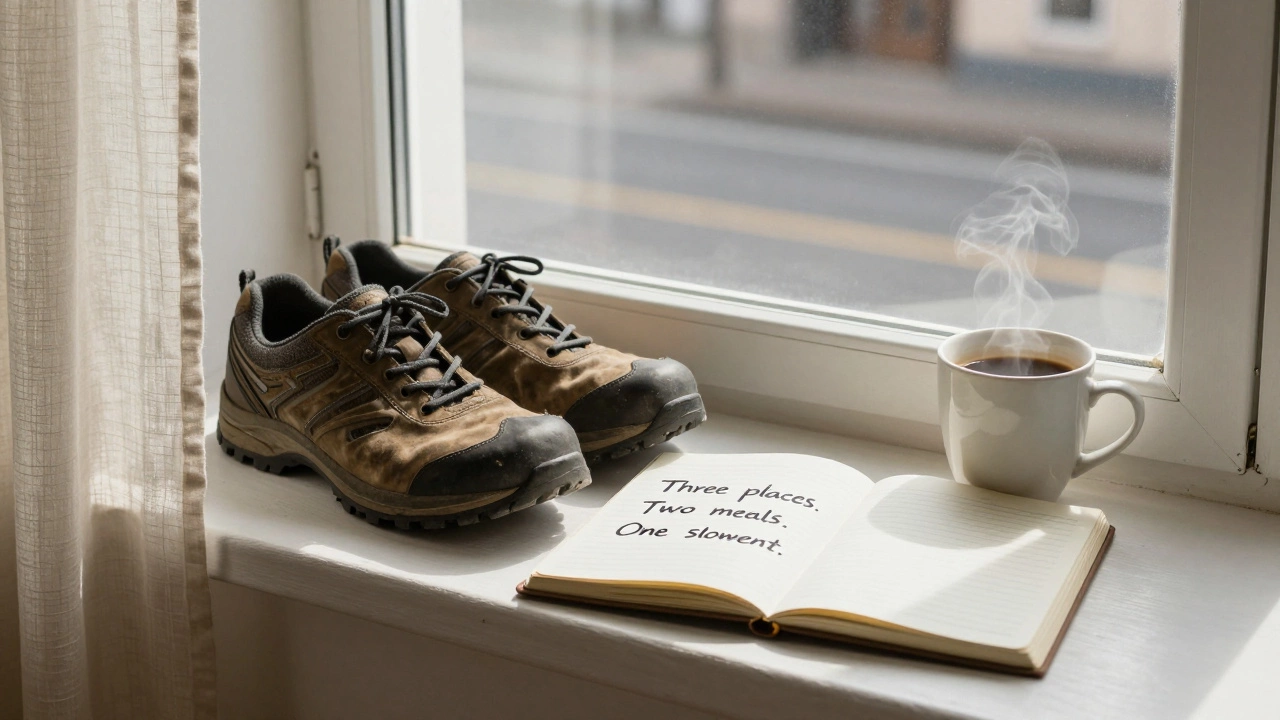
Here’s a simple formula that works: three places, two meals, one slow moment.
- Three places: Pick one cultural spot (museum, church, market), one local hangout (café, pub, park), and one view spot (rooftop, bridge, hill). That’s it. Enough to feel like you’ve seen something, but not enough to burn out.
- Two meals: One lunch in a place locals eat. One dinner where you actually sit down, take your time, and taste the food. Skip the tourist-trap dinner with a €45 tasting menu and 12 tiny plates. Go for a family-run trattoria with a chalkboard menu.
- One slow moment: This is non-negotiable. Find a bench. Sit. Watch people. Don’t take a photo. Don’t check your phone. Just breathe. Even 15 minutes makes a difference. Studies show that even brief pauses in high-stimulation environments reduce cortisol levels by up to 22%.
That’s it. You’re not missing out. You’re actually experiencing more because you’re present.

Where city breaks work best - and where they don’t
Not all cities are created equal when it comes to fatigue. Some are built for slow exploration. Others are built for speed.
Low-fatigue cities: Lisbon, Prague, Bologna, Ghent, Kyoto. These places reward wandering. Streets are narrow, cafés are everywhere, and you can stumble into beauty without planning. You can sit for an hour with a coffee and feel like you’ve done something meaningful.
High-fatigue cities: Paris, London, New York, Tokyo, Barcelona. These are intense. They’re full of must-sees, crowds, and high expectations. You can still enjoy them - but you need to adjust. Skip the Eiffel Tower line. Skip the Louvre’s entire collection. Go to a single wing. Walk along the Seine instead. Let the city surprise you, not schedule you.
Even in high-energy cities, the key is picking your battles. In Tokyo, you don’t need to visit every shrine. One temple, one ramen shop, one quiet garden - that’s enough to feel connected.
How to recover before you even leave
Most people think recovery happens after the trip. It doesn’t. It starts before you even pack your bag.
Three days before your trip, start cutting back on screen time. Avoid scrolling through travel Instagram. Don’t read 15 blog posts about the ‘perfect’ itinerary. Let your brain reset. Sleep an extra 30 minutes. Drink more water. Don’t plan your meals in advance. Leave space for spontaneity.
On the day you leave, don’t rush. If you’re catching a 7 a.m. train, get up at 5:30 - not 4:30. Eat a real breakfast. Don’t try to squeeze in one last errand. You’re not preparing for war. You’re preparing for presence.
What to do when you’re already tired
You’re halfway through your trip. Your feet are killing you. You’re snapping at your partner. You’re scrolling through your photos, wondering why you feel empty. It’s not too late.
Here’s what to do right now:
- Cancel your next planned stop. Seriously. Just delete it from your map.
- Find the nearest park, garden, or quiet street. Sit down. Close your eyes for five minutes.
- Text someone back home - not about what you’ve seen, but what you’re feeling. ‘I’m overwhelmed.’ ‘I just wanted to nap.’ That’s real travel.
- Buy one snack. Eat it slowly. Taste it. Don’t take a photo.
That’s not giving up. That’s recalibrating.
City breaks aren’t meant to be races
The goal isn’t to see everything. The goal is to leave with a memory that sticks - not a checklist that drains you. A city break should feel like a deep breath, not a sprint to the finish line.
Some of the best moments I’ve had in cities happened when I did nothing. Sitting on a bench in Vienna’s Stadtpark, listening to a street musician play a Schubert piece. Eating a croissant in a Parisian bakery while watching rain hit the cobblestones. Finding a tiny bookstore in Prague with no English signs and buying a book I couldn’t read.
Those moments didn’t make it onto my itinerary. But they’re the ones I still remember.
Next time you plan a city break, ask yourself: Do I want to collect experiences - or live one?
Are city breaks worth it if they make you tired?
Yes - if you change how you do them. City breaks aren’t about ticking off landmarks. They’re about slowing down enough to feel the rhythm of a place. Most people get tired because they treat them like a to-do list. The right approach turns them into a reset - not a drain.
How many attractions should I visit on a weekend city break?
Two to three paid attractions max. Add one free experience - like walking along a river or exploring a local market. That’s enough to feel immersed without burning out. More than that, and you’re just moving from one queue to the next.
Is it better to stay in the city center or outside it?
Stay in the center - but only if you’re okay with noise. If you want rest, consider a neighborhood just outside the main tourist zone. In Paris, try the 14th or 15th arrondissement. In Rome, pick Trastevere over the historic center. You’ll save money, get better food, and still be within walking distance or one metro ride from everything.
Do I need to book everything in advance?
Only the big-ticket items - museums, popular restaurants, shows. Skip booking every café, alleyway, or view spot. Leaving room for spontaneity reduces stress and often leads to better discoveries. You’ll find a better taco stand because you got lost - not because it was on a blog.
Can you have a relaxing city break with kids?
Absolutely - but you need to adjust expectations. Skip the long museum tours. Focus on interactive spots: science centers, parks with playgrounds, street performers. Let kids lead. If they want to watch pigeons for 20 minutes, let them. That’s the real magic of city travel - not the monuments, but the small, unplanned moments.
What’s the biggest mistake people make on city breaks?
Trying to do too much. The goal isn’t to see everything. It’s to leave feeling like you’ve truly been somewhere - not like you’ve completed a checklist. The most memorable trips are the ones where you slowed down, got lost, and let the city surprise you.
Next steps for a better city break
Don’t plan your next trip the same way. Start by asking: What do I want to feel? Calm? Inspired? Curious? Then pick your experiences to match that feeling - not your Instagram feed.
Try this: Write down just three words that describe the kind of city break you want. Then delete everything on your itinerary that doesn’t support those words. You’ll be surprised how much you can cut - and how much more you’ll enjoy what’s left.