
How Many Days Do You Need for a City Break? The Perfect Length Guide
 May, 21 2026
City Break Duration Calculator
Find your perfect trip length by answering a few quick questions about your travel style and destination.
Recommended Trip Length
Suggested Itinerary Structure:
There is nothing worse than landing in a vibrant new city, feeling the excitement hit you, and then realizing your alarm is set for six hours from now. Or worse, spending four days wandering around because you booked too much time and ran out of things to do. We have all been there. The question isn't just about budget; it is about rhythm. How many days do you actually need to feel like you've met a city, rather than just glanced at its postcard version?
The short answer? It depends entirely on what kind of traveler you are and which city you visit. But if you want a rule of thumb that works for 90% of destinations, three full days is the sweet spot. It gives you enough time to slow down, make one mistake (like getting lost), recover from it, and still see the highlights without feeling rushed.
The 48-Hour Sprint: When a Weekend Works
Let’s be honest: most of us don’t have unlimited vacation days. A two-night, three-day trip-often called a "weekend getaway"-is the bread and butter of modern travel. Is it enough? For certain cities, absolutely. For others, it feels like a blur.
A 48-hour sprint works best when the city is compact or when you have visited before. Think of places like Paris, a European capital known for its dense historic center where major sights like the Eiffel Tower and Notre Dame are within walking distance or short metro rides. If you know exactly what you want to see, you can tick them off. You hit the Louvre in the morning, walk along the Seine in the afternoon, and enjoy dinner in Le Marais. Done.
However, this format has a hidden cost: transition fatigue. If you fly into a large hub like London or New York, you spend the first four hours dealing with airports, trains, and hotel check-ins. By the time you settle in, you’re tired. Then you sleep. Day one is effectively gone. Day two is your only real day. And then you pack up. That leaves you with barely twelve hours of actual exploration. Is that worth the stress of packing twice as often?
- Best for: Compact cities (Barcelona, Rome, Kyoto), repeat visitors, or couples looking for a quick romantic recharge.
- Risk: High stress, superficial experience, high per-day cost due to flight frequency.
The Three-Day Sweet Spot: Depth Without Drag
This is my personal favorite. Adding one extra night changes everything. Suddenly, you aren’t fighting the clock. You can wake up naturally. You can sit in a café for an hour just watching people. You can take a nap after lunch if the heat gets to you.
Three days allows for a logical geographic flow. On day one, you conquer the main tourist zone. On day two, you venture into a local neighborhood-maybe a market district or an artsy quarter. On day three, you revisit a favorite spot or catch a museum you missed. This structure reduces decision fatigue. You aren’t scrambling to fit everything in; you are curating an experience.
Consider Berlin, a sprawling German capital with distinct districts like Mitte, Kreuzberg, and Neukölln, each offering vastly different vibes and attractions. In two days, you might see the Brandenburg Gate and Museum Island. In three days, you can add a walk through the East Side Gallery, a beer garden in Prenzlauer Berg, and a late-night dive bar in Friedrichshain. The difference between seeing Berlin and *feeling* Berlin is often that third day.
The Five-to-Seven Day Deep Dive: Living Like a Local
If you have the time, five to seven days transforms a "trip" into an "immersion." This is where you stop being a tourist and start acting like a resident. You buy groceries instead of eating out every meal. You discover the park where locals jog. You learn which bus route avoids traffic.
Longer stays are essential for larger, complex cities. Take New York City, a massive metropolis comprising five boroughs, requiring significant transit time between neighborhoods like Manhattan, Brooklyn, and Queens. You cannot do NYC in three days unless you plan to stand in line for the Statue of Liberty for six hours and eat nothing but pizza slices. With five days, you can spend a full day in Central Park, another in MoMA and the Met, and still have time to explore Chinatown or DUMBO without panic.
There is also the psychological benefit of "settling in." After the first 48 hours, the novelty wears off slightly, and you begin to notice details. The architecture of a side street. The smell of a specific bakery. The sound of the tram bells. These small moments create lasting memories, not just checklist items.
| Travel Style | Recommended Days | Best For Cities Like... | Key Benefit |
|---|---|---|---|
| The Efficient Sightseer | 2-3 Days | London, Paris, Amsterdam | Low cost, minimal time off work |
| The Balanced Explorer | 3-4 Days | Berlin, Barcelona, Rome | Good mix of hits and local flavor |
| The Immersive Traveler | 5-7 Days | New York, Tokyo, Istanbul | Deep cultural connection, less stress |
| The Multi-City Hopper | 2 Days per City | Amsterdam -> Brussels -> Paris | Maximum variety, high transit tolerance |

Factors That Change the Equation
It is not just about the calendar. Several external factors dictate how long you should stay. Ignoring these can turn a dream trip into a nightmare.
1. The Size and Layout of the City Compact cities reward short stays. Sprawling cities punish them. Tokyo, a vast Japanese metropolitan area with multiple distinct centers like Shinjuku, Shibuya, and Asakusa, connected by an extensive rail network is technically one city, but moving from west to east can take an hour. If you book three days in Tokyo, you will likely spend half of it on trains. Seven days feels more appropriate to truly grasp its scale.
2. Your Pace and Energy Levels Are you a "hit-the-ground-running" type who starts planning hikes at 6 AM? Or do you prefer slow mornings with coffee and reading? If you are high-energy, you can compress a four-day itinerary into three. If you value relaxation, extend any trip by one day. Burnout is real, even in paradise. I once tried to see all of Prague in 48 hours. I ended up sitting on a bench in Old Town Square, exhausted, watching other tourists enjoy the view while I counted my steps.
3. The Season and Events Timing matters. If you visit during a major festival-like Oktoberfest, an annual beer festival held in Munich, Germany, attracting millions of visitors and causing severe accommodation shortages and crowds in Munich or Carnival in Rio-you need more time. Crowds move slower. Lines are longer. Spontaneity dies. Add an extra day to buffer against delays. Conversely, in off-season months, you can cover more ground faster because streets are emptier and services are quicker.
The Hidden Costs of Short Trips
We often think shorter trips are cheaper. Sometimes they are. But look closer. Flights are rarely discounted for last-minute or same-week bookings unless you are lucky. Hotels charge higher rates for weekend stays (Friday-Sunday) compared to mid-week nights. So, a two-night Friday-to-Monday trip might actually cost more per night than a four-night Tuesday-to-Friday stay.
Then there is the "transition tax." Packing, commuting to the airport, security checks, waiting for luggage, finding your hotel, unpacking, repacking, returning home. All this takes energy and time. If you only get 24 hours of actual fun for 40 hours of total effort, is it efficient? Often, extending a trip by one day dilutes the impact of these fixed costs. You pay the same for the flight, but you get 33% more enjoyment.
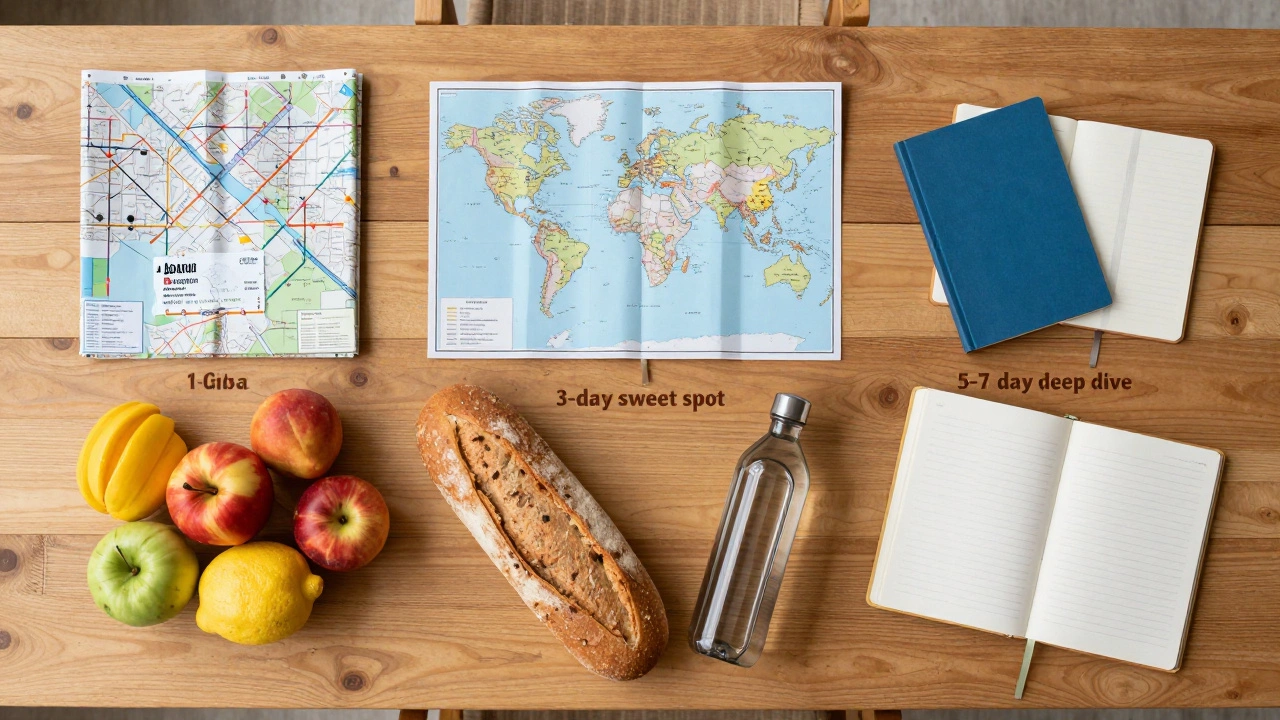
How to Plan Based on Duration
Your itinerary strategy should shift based on how long you are staying. Here is a practical guide to structuring your days.
For 2 Days: Focus on Geography Pick one neighborhood. Stay there. Eat there. Walk everywhere. Do not try to cross the city. If you are in Rome, stick to the Historic Center. If you are in New York, stick to Midtown or Downtown. Minimize transit time. Book tickets in advance for any major attraction to avoid wasting precious hours in line.
For 3-4 Days: Balance Hits and Gems Day 1: The Classics. See the famous landmarks. Get the photos. Check them off. Day 2: The Local Vibe. Go to a market, visit a lesser-known museum, or take a guided food tour. Talk to locals. Day 3: The Wildcard. Leave this day open. Follow your curiosity. If you loved the art museum, go back. If you found a great park, spend the afternoon there. Flexibility is luxury.
For 5+ Days: Live the Rhythm Structure your week like a local. Mornings for culture (museums open early). Afternoons for leisure (cafés, parks). Evenings for dining and nightlife. Use one day for a day trip outside the city if possible-like taking a train to Versailles from Paris or Nara from Kyoto. This breaks up the urban monotony and adds variety.
Common Mistakes to Avoid
- Overbooking Activities: Never schedule more than two major activities per day. One morning, one afternoon. Everything else is bonus. Overplanning leads to skipping meals and rushing.
- Ignoring Transit Time: Always check Google Maps for realistic travel times between points. A 10-minute walk might be 30 minutes if you are carrying heavy bags or navigating confusing subway stations.
- Staying in the Wrong Location: For short trips, location is king. Pay extra to stay in the center. For longer trips, you can afford to stay further out to save money, as you will have time to commute comfortably.
- Skipping the "Do Nothing" Day: Especially on longer trips, schedule one half-day with zero plans. Rest is part of the experience. Jet lag is real, and pushing through it ruins the joy of discovery.
Ultimately, the right number of days is the one that lets you leave feeling satisfied, not drained. It is better to return home wanting more than to return home hating the city because you were too busy running to breathe. Listen to your pace, respect the city's size, and give yourself the gift of time.
Is 2 days enough for a city break?
Two days is enough for a quick overview of compact cities like Paris, London, or Barcelona if you focus on one or two neighborhoods. However, it will feel rushed, with significant time lost to travel and logistics. It is best suited for repeat visitors or those with very limited time.
How many days do you need for New York City?
For a first-time visitor, 4 to 5 days is ideal. NYC is huge, and traffic/transit can be slow. This allows you to see major icons like Times Square and Central Park while also exploring diverse neighborhoods like Brooklyn or Harlem without feeling exhausted.
Is it better to visit multiple cities in one trip or stay in one?
If you love variety and don't mind packing/unpacking frequently, multi-city trips are great. However, staying in one city for 4-5 days offers deeper immersion, lower stress, and often better hotel rates. For beginners, sticking to one city is recommended to avoid "hotel hopping" fatigue.
What is the minimum time needed to see Rome?
You can see the main highlights of Rome (Colosseum, Vatican, Trevi Fountain) in 3 days. However, Rome has so much history and food culture that 4-5 days is preferred to fully appreciate the atmosphere and visit sites like Ostia Antica or Villa Borghese.
Does the season affect how long I should stay?
Yes. During peak seasons or festivals, crowds slow you down significantly. Add an extra day to your itinerary during summer or major events to account for longer lines and crowded streets. In off-seasons, you can often cover more ground in less time.